| Reagan Library Iran Contra Album |
The second Boland Ammendment was passed on October 12, 1984.
The statutory provision cutting off funds, known as the second Boland Amendment, was part of a fiscal year 1985 omnibus appropriations
bill, and was signed into law by the President on October 12, 1984. It was buried in the thousands of pages of the bill on one page.
President Reagan never admitted he did not know it was in the appropriations bill but it is well known he did not want this as law. It read:
"No appropriations or funds made available pursuant to this [authorization bill] to the Central
Intelligence Agency, the Department of Defense, or any other agency or entity of the United States involved in intelligence activities may
be obligated or expended for the purpose or which would have the effect of supporting, directly or indirectly, military or paramilitary
operations in Nicaragua by any nation, group, organization, movement, or individual."
For all intents and purposes, this amendment prohibited the funding of the contras with U.S. government funds.
The statutory provision cutting off funds, known as the second Boland Amendment, was part of a fiscal year 1985 omnibus appropriations
bill, and was signed into law by the President on October 12, 1984. It was buried in the thousands of pages of the bill on one page.
President Reagan never admitted he did not know it was in the appropriations bill but it is well known he did not want this as law. It read:
"No appropriations or funds made available pursuant to this [authorization bill] to the Central
Intelligence Agency, the Department of Defense, or any other agency or entity of the United States involved in intelligence activities may
be obligated or expended for the purpose or which would have the effect of supporting, directly or indirectly, military or paramilitary
operations in Nicaragua by any nation, group, organization, movement, or individual."
For all intents and purposes, this amendment prohibited the funding of the contras with U.S. government funds.
| Timetable of events concerning aiding the Contra's who were fighting to keep communism out of Nicaragua. It includes the Boland Amendments which the Democratic controlled House passed to stop funding of aid to the anti-communist Contra's. |
| The Marxist leader of Nicaragua that the Contra's were trying to stop. He was turning Nicaragua into a communist country. |
| President Reagan had what the press identified as a scandal worthy of impeachment. Just what was it? |
| Timetable of events leading up to Congress investigating the funding of the Contra's in Nicaragua. |
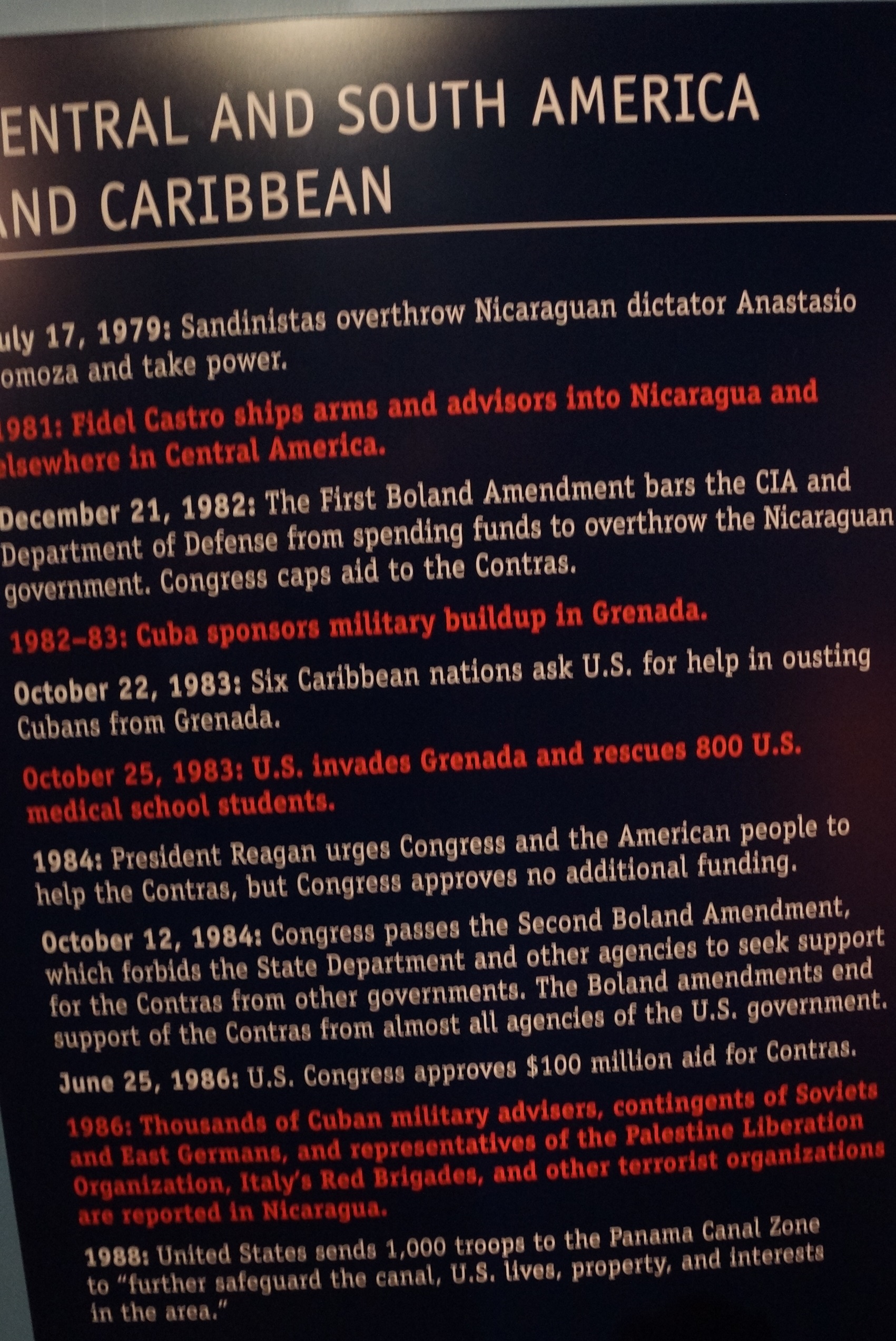


| What are the Boland Amendments? |
The first Boland Amendment was passed on December 21, 1982. It is named after Congressman Boland (D. Mass.)
As contra attacks continued throughout 1982, the U.S. press began to report on U.S. support for the rebels. Liberal Democratic members of
Congress condemned the policy, arguing that it was immoral and perhaps illegal. Eventually, Congressman Edward Boland (D-MA), Chairman
of the House intelligence committee, offered an amendment “prohibiting the use of funds ‘for the purpose of’ overthrowing the government
of Nicaragua or provoking a war between Nicaragua and Honduras” which became law on December 21, 1982. The use of funds for this
purpose had actually been secretly prohibited per an agreement between Congress and the White House; thus, the amendment had no
practical effect on the conduct of U.S. policy. Kagan identifies a “loophole” in the law; namely, that as long as the United States itself did not
intend to overthrow the Nicaraguan government, the United States could support the contras, who did have that intent. Indeed, according to
a PBS Frontline documentary, the first Bolland Amendment did not affect the conduct of the war in Nicaragua.
As contra attacks continued throughout 1982, the U.S. press began to report on U.S. support for the rebels. Liberal Democratic members of
Congress condemned the policy, arguing that it was immoral and perhaps illegal. Eventually, Congressman Edward Boland (D-MA), Chairman
of the House intelligence committee, offered an amendment “prohibiting the use of funds ‘for the purpose of’ overthrowing the government
of Nicaragua or provoking a war between Nicaragua and Honduras” which became law on December 21, 1982. The use of funds for this
purpose had actually been secretly prohibited per an agreement between Congress and the White House; thus, the amendment had no
practical effect on the conduct of U.S. policy. Kagan identifies a “loophole” in the law; namely, that as long as the United States itself did not
intend to overthrow the Nicaraguan government, the United States could support the contras, who did have that intent. Indeed, according to
a PBS Frontline documentary, the first Bolland Amendment did not affect the conduct of the war in Nicaragua.
| What was the affect of the Second Boland Amendment? |
| It put President Reagan into a box. Either he stop funding the anti-communist Contras in Nicaragua or he breaks the law if he funds them with taxpayer money. President Reagan could not abandon the anti-communists fighters. He needed a way to fund them. |
| What was then done to fund the anti-communists fighters, the Contras? |
1. During the year 1985 Oliver North worked to get private donations to
fund the Contras. At the same time they were working to free hostages held
by Iran. Money was needed for the Contras.
fund the Contras. At the same time they were working to free hostages held
by Iran. Money was needed for the Contras.
2. Iran needed weapons in their fight against Iraq. They were willing to pay
any price. In the following weapon sales a number of hostages were freed
as well as millions of profit made from the sales. The profit from the sales
was diverted as military aid to the Contras in Nicaragua. The following
happened:
In early April, 1986, North wrote a memo to Poindexter in which he wrote that
$12 million of the profit Secord and Hakim made from the sale of arms to Iran
“will be used to purchase critically needed supplies for the Nicaraguan
Democratic Resistance Forces”, this became known as the “diversion.” On
November 25, 1986, in the midst of growing attention paid to the arms deals
to Iran, Attorney General Edwin Meese III announced the diversion. Of all of
the events of the Iran-Contra Affairs, this was arguably the most explosive.
3. The Democrats immediately pounced on it and the next day the Tower
Commission started the investigations followed by an Independent Council
Lawrence Welch on December 19, 1986, the Congressional Investigation in
January 1987 and finally March 6, 1987 the Democrats introduced articles of
Impeachment in the House of Representatives.
4. The press made a huge issue out of arms for hostages. The press
pointed out it was ransom. The narrative of the press in 1987
was that Reagan was paying ransom for hostages by selling Iran arms.
5. The narrative of the press in 2016 was much different. On Jan. 16, 2016,
the same day four American detainees were released in Iran, a jumbo jet
carrying $400 million in euros, Swiss francs and other currencies landed in
Tehran. That money purportedly was partial payment of an outstanding claim
by Iran for U.S. Military equipment that was never delivered. Soon after the
first cash delivery, $1.3 billion in cash followed. The Obama administration
insisted it was not money for hostages. The press agreed and the issue was
just a blurb in the news for a couple days.
any price. In the following weapon sales a number of hostages were freed
as well as millions of profit made from the sales. The profit from the sales
was diverted as military aid to the Contras in Nicaragua. The following
happened:
In early April, 1986, North wrote a memo to Poindexter in which he wrote that
$12 million of the profit Secord and Hakim made from the sale of arms to Iran
“will be used to purchase critically needed supplies for the Nicaraguan
Democratic Resistance Forces”, this became known as the “diversion.” On
November 25, 1986, in the midst of growing attention paid to the arms deals
to Iran, Attorney General Edwin Meese III announced the diversion. Of all of
the events of the Iran-Contra Affairs, this was arguably the most explosive.
3. The Democrats immediately pounced on it and the next day the Tower
Commission started the investigations followed by an Independent Council
Lawrence Welch on December 19, 1986, the Congressional Investigation in
January 1987 and finally March 6, 1987 the Democrats introduced articles of
Impeachment in the House of Representatives.
4. The press made a huge issue out of arms for hostages. The press
pointed out it was ransom. The narrative of the press in 1987
was that Reagan was paying ransom for hostages by selling Iran arms.
5. The narrative of the press in 2016 was much different. On Jan. 16, 2016,
the same day four American detainees were released in Iran, a jumbo jet
carrying $400 million in euros, Swiss francs and other currencies landed in
Tehran. That money purportedly was partial payment of an outstanding claim
by Iran for U.S. Military equipment that was never delivered. Soon after the
first cash delivery, $1.3 billion in cash followed. The Obama administration
insisted it was not money for hostages. The press agreed and the issue was
just a blurb in the news for a couple days.
| What was the outcome of the investigations? |
1. The investigations continued until 1993. The charges were unauthorized
use of government funds, illegally selling weapons to Iran, trading arms for
hostages in violation of a longstanding US policies, and misleading
Congress and the American people. The passage of the Boland Amendment
and the following "Independent Counsel" investigation resulted in many
lawyers becoming millionaires.
2. In the end, fourteen administration officials were indicted, including
then-Secretary of Defense Caspar Weinberger. Eleven convictions resulted,
some of which were vacated on appeal. The rest of those indicted or
convicted were all pardoned in the final days of the presidency of George H.
W. Bush, who had been Vice President at the time of the affair.
3. On March 4, 1987 President Reagan took full responsibility for the
Iran/Contra affair in a speech to the nation.
use of government funds, illegally selling weapons to Iran, trading arms for
hostages in violation of a longstanding US policies, and misleading
Congress and the American people. The passage of the Boland Amendment
and the following "Independent Counsel" investigation resulted in many
lawyers becoming millionaires.
2. In the end, fourteen administration officials were indicted, including
then-Secretary of Defense Caspar Weinberger. Eleven convictions resulted,
some of which were vacated on appeal. The rest of those indicted or
convicted were all pardoned in the final days of the presidency of George H.
W. Bush, who had been Vice President at the time of the affair.
3. On March 4, 1987 President Reagan took full responsibility for the
Iran/Contra affair in a speech to the nation.